Mayor promises cleaner air across Solihull after inspiring visit to local schoolchildren
By Sam Greenway - Local Democracy Reporter 17th Nov 2026
The West Midlands Mayor has given a fresh commitment to improving air quality in Solihull and the wider region.
Richard Parker said there is no "silver bullet" but the government is taking action to ensure cleaner air across the West Midlands in the future.
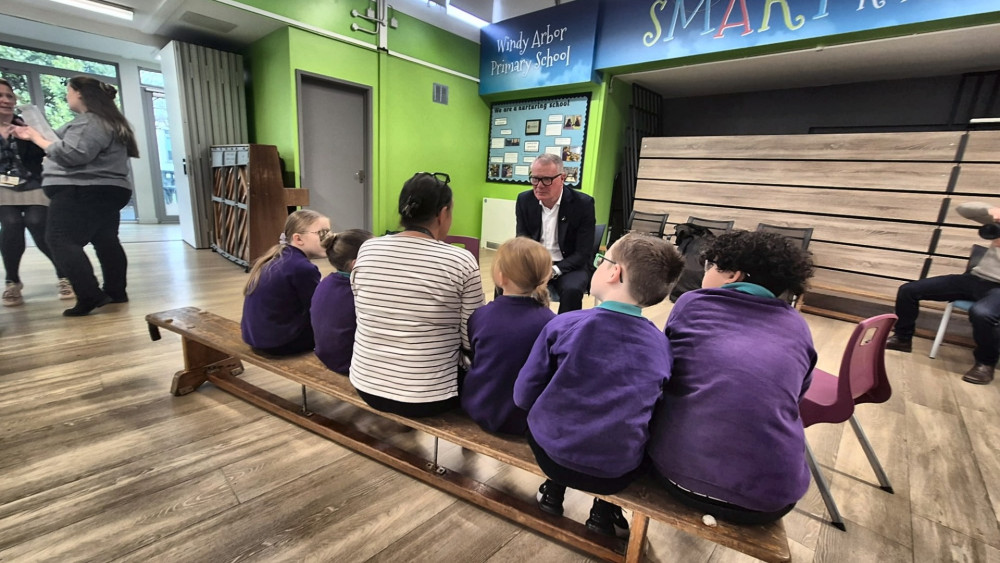
The mayor spoke to the Local Democracy Reporting Service (LDRS) at the launch of a new region-wide, air quality education programme at Windy Arbor School in Chelmsley Wood.
The Air Quality Toolkit shows children how to protect their health by recognising sources of pollution and the changes they can make to their daily routines such as walking to school instead of by car, to help improve air quality.
Pupils performed during an assembly at one point asked the mayor if he would act, Mr Parker replying: "That's our plan – I've been inspired by the work you are doing."
Following the assembly he told the LDRS: "It is great the West Midland Combined Authority (WMCA) is educating children and engaging them to understand how air quality impacts their lives.
"What they are learning is relevant to their future."
As politicians have struggled to tackle the issue in the past, the mayor said the government and WMCA had a strategy for meaningful change.
"There's no safe level of air pollution, it's one of the biggest environmental risks to our health," the mayor said.
"It's about how we build the green energy of the future. We need to build more homes that are energy efficient, we're investing in retro-fitting homes, and a transition to EV vehicles.
"The difference has to be multifaceted."
Analysis of the latest air quality data by the WMCA shows levels of harmful nitrogen dioxide (NO₂) are steadily falling across all seven local council areas, with average reductions of between 20 per cent and 40 per cent.
The data, which is for 2019-2025, also shows Solihull is the borough seeing the biggest drop in NO₂ levels across all seven WMCA council members – around 40 per cent.
But Kirsten de Vos from campaign group Mums for Lungs said: "It is getting better but we are nowhere near where we need to be.
"Things are generally going in the right direction but we need to be doing more to protect children."
She added while electric vehicles were part of the solution the main aim should be to encourage people to drive less and instead walk, cycle or use public transport.
Last year the mayor launched one of the UK's most advanced regional air quality monitoring networks with 90 sensors.
The data gathered is helping to guide action to reduce exposure to harmful pollutants with the monitors linked to a website showing near real-time pollution levels and a live alerts system when levels spike.
An updated air quality action plan is expected to be published by the WMCA early next year with new standards on PM2.5 particulates, and NO2 levels which are set to be more ambitious than those currently set at national and international level.
Download our Nub News App:
- It’s FREE and available now
- Breaking news notifications
- Your Town in Your Pocket


Share: